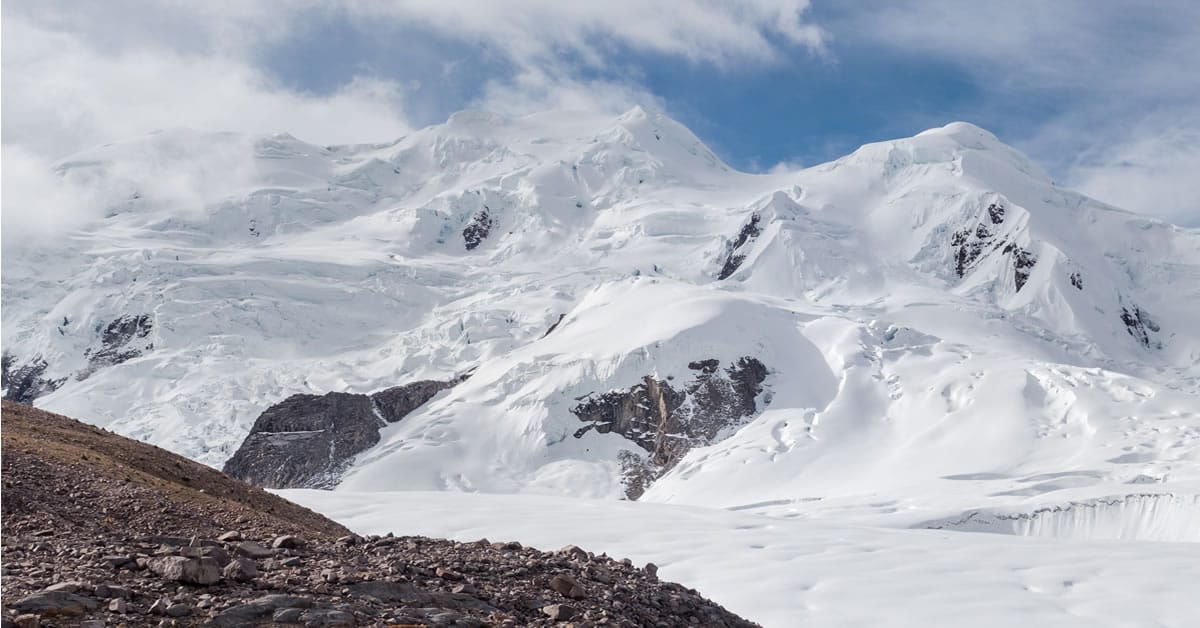
In recent years I have visited Peru, Huaraz more specifically, several times for skiing. Together with Ale, an Italian mountain guide living in Peru, I managed to ski several mountains in the region. During our last adventure we discussed the possibilities to ski in the Cusco region. Although Cusco is really popular and sees many tourists every year, the Cordillera Vilcanota with a few beautiful mountains, is still relatively unknown. Both of us have never been there for skiing and the remoteness, lack of people and skiing a 6000-er convinced us easily. April 21, 2025 we met in Cusco for a ski expedition to Chumpe.
Cusco

First things first. Before I would meet with Ale, I would make sure to be acclimatized and all set for the expedition. I flew to Cusco ten days earlier to get adjusted to the higher elevations. I flew from Amsterdam to Bogota via New York, spent one night in the Colombian capital in a sketchy neighborhood adjacent to the airport, before flying into the seventh largest city of Peru. I had visited this beautiful city in 2013 and was curious to see to what extent it had changed.
As anywhere in the world, tourism has picked up in Cusco. Given the beauty of the city and the major attraction of Machu Picchu in its vicinity, it was filled with tourists from all over, but in particular with Israelis. At times it felt like Hebrew was the language spoken in Cusco. Not a pleasure on the ears to be honest. All the cobblestone streets I remembered from my first visit were still there and the many annoying touts trying to sell mostly drugs and massages were, unfortunately, also still around in the historic center…

The main objective in Cusco was to acclimatize. A couple days wandering around in the city followed by a day hike would be enough to start the 5-day trek around Ausangate. Unfortunately, my trek had been cancelled a few days before arriving. Apparently, all the other clients were sick. Eventually the agency found me a similar trek with another agency with departure on the same date. He guaranteed that the guide would speak English and I would join three Americans. Sounded ok to me.
I still had a few days to kill so tried out a few of the many nice restaurants the town has to offer. I quickly found a nice little restaurants which offered an amazing lomo saltado, stir-fried beef with onions and tomatoes, rice and fries on the side. After my day hike around the city to visit Cristo Blanco and Saqsaywaman, I found a lovely burger restaurant in the neighborhood of San Blas. At Chakruna Native Burgers they offer all kinds of burgers from the regular one with minced meet, to single and double Alpaca burgers. They are served with six different sauces and delicious homemade fries, highly recommended!

My hike to Cristo Blanco was meant as a preparation for the 5-day Ausangate trek later on. From the top of town, it’s another 150 vertical meters to reach the giant statue of Jesus Christ, overlooking the city. My plan was to follow the road up and around Saqsaywaman in order to get more exercise. Saqsaywaman is a complex resembling the head of a lion which is completed by the rivers (tail) and main square with the surrounding houses (body).
The entrance fee to the sight is rather steep but when I found a sneaky path from the top, I decided to explore and soon found myself in the middle of the lion’s head. The construction is said to have been built in the 15th century with an amazing precision and consists of huge stones. To imagine that the Incas have built this centuries ago, is rather unbelievable, inspirational and amazing at the same time. Or is it perhaps simply impossible?

Before starting the trek, I wanted to visit the Mercado Central de San Pedro. Markets are usual fun to visit, with a lot of things going on. A variety of produce is on offer, food stalls are abundant and it’s a great place to play around with the camera. On my previous visits to South America, I fell in love with the so-called ‘batido’, fruit with milk and a bit of sugar mixed in the blender. This indoor market offered a whole section with ladies offering fruit juices. They each tried to get my attention by waving with their menu and shouting ‘papi, papi!’. I looked for an adorable older woman and a few minutes later I was sipping my ‘arándano batido’ (blueberry milkshake), the perfect preparation for my 5-day trek in the nearby mountains.
The Ausangate trek
April 15 at 4 am I was picked up by Juan, the guide, who was accompanied by a very young cook and an arriero, the guy managing the logistics by transporting all the equipment and food by using horses (donkeys in the North of Peru). In the back was one other guy, who was already on a very long phone call. (4 am, remember…). The promised three Americans were nowhere to be found, apparenty I was together with one Israeli and the guide hardly spoke any English. So much for the promises of the travel agency…
When the Israeli had finally finished his phone call, he mentioned I looked very well prepared and that he had no interest in details about elevations and distances because he couldn’t change it, he simply had to deal with it. He also mentioned that he chose this trek because it was the hardest one around Cusco. He liked extremes. It was also his first trek ever. It’s an understatement to say that I did not had very warm feelings for this guy…

Soon, he realized the elevations might be a bit too ‘extreme’. Headaches and cardiac arrhythmia made him abandon the trek at day two. For the remainder of the trek I was alone with the staff. No surprise, I wasn’t sad about it. The lack of stupid comments and being able to eat without having to look and listen to some delicious chewing with open mouth all made the trek much more enjoyable. From now on I only had to deal with Juan’s urge to tell me in detail about the history of the Incas. I guess he thought my Spanish was way better than it actually was…

In the afternoon of day two, we hiked towards the famous and ridiculously popular Rainbow mountain, or ‘La montaña de los siete Colores’ (which actually has only four colors…). Together with Juan and the cook (he had never visited Rainbow mountain before), I reached the sight in a terrible hailstorm after about an hour or so from camp. As a result, the mountain was almost deserted and tourists could be counted on one hand. Unfortunately, it also meant we were getting really cold and potential sickness was looming…

The next morning it was bingo, daddy was feeling sick. With two serious passes of around 4.800 meters to cross this day, it wasn’t very promising. My temperature was higher than it’s supposed to be and my stomach was acting weird. I had no choice though but to get moving, significantly slower than usual though. Nevertheless, I slowly progressed and made it to the first pass.
In order not to exhaust myself completely, the staff came up with an alternative route to the campsite near Ausangate Cocha (the lake below the mighty Ausangate) which avoided the second pass. Several hours later, we reached the campsite which we shared with a Belgian couple. After a small chat, it turned out they were hiking with what seemed like a small pharmacy. They provided several tablets which I ate like candy, I was happy to try whatever medicine was available!

At this point I was seriously considering to abandon the trek. If I felt the same or worse the next morning, I would quit. At least, that’s what I told myself. Being alone with a Spanish speaking staff in the middle of nowhere at 4.500 m in a tent, can feel pretty lonely, let me tell you that. After one of the worst nights ever (I had to sit up every 20 minutes and get rid of all the gas in my stomach to prevent myself from vomiting), it can’t be a surprise that I felt worse than the day before. With the highest pass of the trek on the agenda for the day, I prepared to go ‘home’. After a sober breakfast and a refill of the Belgian pharmacy however, I miraculously started to feel better. Merely an hour later, I was packed and ready to conquer the Palomani pass…
The beauty of the Ausangate trek is that it’s very, very quiet. The vast majority of tourists in Cusco come either to ‘just’ visit Machu Pichu, do the Inca trek or the Salkantay trek. As a result, you’ll be almost alone on the Ausangate trek. In addition, the people I met during the first two days, all went back to Cusco due to altitude sickness. Except the Belgians, they were here to look after me, muchas gracias amigos!

After a few hours, I finally reached the highest pass of the trek. With an altitude of 5.200 meters, it offers spetacular views all around. It was extremely pieceful to be there and take in the views. Juan had played his Andean flute several times to ask Pachamama (Mother Earth and most important goddess revered by the indigenous people of the Andes) to make me better. It’s nice at this point to believe it helped. In addition to the Belgian pharmacy of course…
The way down from Palomani pass went smoothly and soon we found ourselves having lunch in a shelter down in the valley. The last couple days I had seen delicious plates entering the table without being able to enjoy them due to my sickness. Lomo saltado was the culinary highlight of the trek but daddy had to pass. This time I would eat whatever the chef had prepared, I promised myself. And so I did. Less than 30 minutes later, when we hit the trail again, I suffered from severe stomach cramps. They were so bad that I could hardly walk ten steps on the flat. Isn’t life beautiful…

The final campsite of the trek was still a few hours away and I had to take a break every 5 minutes. The only way to keep going was to convince myself this would be the perfect mental preparation for high altitude ski mountaineering. The ability to suffer is an important skill to have at high altitude. As a result, I kept going and going until we finally reached the campsite. Unfortunately the Belgians had moved on by now. Their blunt and arrogant neighbor had progressed too slowly. From now on, only Pachamama could help me because the pharmacy was out of reach…
No more regular meals, no more powdered milk but just very sober meals, I kept telling myself. For dinner I had a basic soup with chicken fillet and a chamomile tea. My stomach seemed to relax overnight so I had a refill for breakfast. No sauces, no sugar, no surprises I hoped. We packed our stuff and started the day during which we had to cross the Qampa pass (5.100 meters) and go down to Pacchanta. Final push Paul, final push…

Despite the hailstorm on day two, we had been blessed with beautiful weather during most parts of the day. The last day of the trek was no different. With blue skies, Juan and I enjoyed the ascent to Qampa pass. The diet seemed to have paid off as I was gaining strength and started to feel better again. The scenery changed rapidly as we approached the pass. The lush green pastures had been replaced by dry rocky paths with steep mountains on the side. Soon, we reached the last pass of the trek and time had come to descend to Pacchanta, the final destination of the 5-day trek.
A few hours later we were back in civilization. Since Pacchanta is also the starting point of the 7-lakes tour, the place was full of tourists. After five days in solitude, it was quite a shock to be honest. Many ‘shaloms’ later, we were organizing our equipment together with the chef and arriero. I enjoyed some trout and a milanesa (chicken schnitzel) with Juan and time had come to jump in the car for the ride back to Cusco. Several hours later I was back in the city and enjoying a delicious lomo saltado at Sumaqcha. I was now ready for the next step of the adventure and real objective of the trip: the ski expedition to Chumpe.
Organizing the ski expedition
Last year I visited Huaraz and skied with Ale. In the tent we usually talk about several ski destinations and possible expeditions. That time, Bolivia and the Cusco region were hot topics. The Cordillera Vilcanota, a mountain range located southeast of the famous city, is home to Nevado Chumpe (6.106 m). This mountain has first been skied in 2018 by Mike and Steve Marolt, two of the most accomplished high altitude ski mountaineers of the US. I thought it would be a nice adventure to explore this area and make a ‘second descent’ (and first Dutch descent 🙂 ) in a remote and wild region. Ale liked the idea (it would most likely be a first snowboard descent for him) and in April 2025 we met in Cusco to make it happen.

When I met Ale however, his luggage had not yet arrived. Apparently it had been shipped to the jungle. As a result, we could only start our expedition three days later. In the meantime we did the grocery shopping for the trip. Fifty bread, a kilo of cheese, 12 bags of pasta, 16 cans of tuna, a lot of tomato sauce, powdered milk, powdered chocolate, plenty of bags of oatmeal, 16 eggs and a lot more, had to be carried with us in order to survive several days in the high camp from where we would attempt one or more summit pushes and descend from 6.106 meters.
Finally moving
Friday April 25, Ale’s luggage had finally arrived and we could move to Phinaya. This tiny settlement at 4.800 m. in the middle of nowhere would be our first stop. In Cusco we hopped on a bus to Sicuani . Three hours later, we enjoyed some ceviche, trout and chicken in the capital of the Canchis province where we were picked up by David. A 4×4 was required to reach Phinaya. Late in the afternoon, just before dusk, we arrived at the Yayamari lodge. In this case, lodge is a fancy word for a bunch of walls that were about to fall apart. Let’s say it added to the adventure…

After a surprisingly good sleep, we moved on towards base camp. David dropped us at Roberto’s house, a cabin with no one else to be found for kilometers, about an hour from Phinaya. Here, our luggage would be transferred to horses. While Roberto guided the horses alongside Sibinacocha, a huge and gorgeous lake, Ale and I had to walk. It was a good way to accclimatize further and get back into the rhythm of physical exercise.
The hike took about three hours. The base camp was located at the end of the lake which seemed to just keep on going after every corner. It was a beautiful hike though through lush green hills with big mountains behind it. We passed Yayamari (6.049 m) and Ausangate (6.336 m) on the other side of the lake. Finally, we got a glimpse of Chumpe when we got closer and closer to the base camp. When we set up camp, a local farmer approached us with his three dogs. He simply wanted to know what we were doing there. It showed the remoteness and lack of climbers, let alone skiers. After Ale had given him a handful of coca leaves, he returned satisfied to his llamas and alpacas.

We had arranged that horses would support us to high camp. Roberto was not available but David turned out to be a jack of all trades. Driving a 4×4, steering a boat, working as a porter or arriero, he could do it all. So, the next morning, after some fresh snowfall, David showed up with the horses. We were a bit anxious having to carry everything ourselves due to the weather conditions, but when the sun had cleared the fresh snow, we knew everything would be ok. The glacier appeared to be very close, so both Ale and I couldn’t imagine it would take about three hours to get to the high camp but David assured us it would.
We walked through the moraine with our light packs, crossed a river and followed David and the horses while we slowly gained elevation. Of course, David was correct and the moraine seemed to be endless. There was a new field of rocks after every corner and false summit. On our way to high camp, we noticed four wildlife cameras in the upper section of the moraine. Apparently, Chumpe is home to a population of pumas which is monitored because they are in serious danger of extinction. Imagine to leave the tent for a toilet break only to come face to face with this incredible cat! Yes, at 5.300 m. we had established our temporary home in a seriously remote and wild area…

According to the Americans who claimed the first descent of Chumpe, one could spend days to ski several lines, which had caught our attention. From the vicinity of our camp we tried to spot as many lines as we could. In the end, we came up with a maximum of three lines if lines with a multitude of rappels were excluded. It quickly showed however, that weather conditions restricted the number of possible lines even further…
Almost to the summit
Filled with excitement, we woke up the first day at a convenient 4 am. For a change, I’m not being cynical here, this is seriously convenient in the high mountains. You usually go to bed at 7 or 8 pm since the cinema is not nearby and you’d have to travel days for a craft beer. And remember, you’re here for one reason only and that’s to climb and ski or snowboard…
After a hot chocolate and some oatmeal, we started to explore the glacier for an acclimatization run. We had our hopes set on a small summit looker’s right, one of the three potential lines. The labyrinth of crevasses at the lower part of the glacier seemed to be too complex in combination with the bad visibility that we had to change plans. The maximum number of lines had already been reduced to two…

We decided to follow the main route to the summit and stop halfway on top of a huge crevasse where a plateau would allow us to transition into ski mode easily. This way, we could familiarize ourselves with the main route and acclimatize nicely since this was already around 5.600 m. We also had a glimpse at our other potential line, one valley over to the right. It seemed to be possible, although the actual descent was out of sight. Something for the days to come, perhaps…
During the descent, the weather came in and we quickly went down in order to find the exit of the glacier. The rest of the day, the weather stayed unstable with a lot of hail but also spells of sunshine. We enjoyed lunch, took a nap, had some chai and continued our tuna-pasta regime. Since Ale and I started skiing together, we always eat pasta with tuna, sometimes with a bit of reluctance. It’s easy though and fills the stomach pretty well. Despite the variable weather, day 1 can be labeled as success; we had completed our acclimatization run and got familiar with the summit route. Time to move on!

Day 2 started at the same time and with a lot of excitement. After all, it was ‘summit day’. After our usual morning routine of chocolate and outmeal, we found ourselves at the bottom of the glacier around 5 am to start the ascent. We both felt strong and progressed quickly. It wasn’t even 7 yet when we were back at the plateau. From there, the terrain got steeper and a seemingly endless series of steep switchbacks took us passed some sketchy terrain with overhanging seracs and a huge crevasse below us. In other words, we had no time to slow down or lose our focus. Around 9 am, we reached the col at 6.000 meters. From there, only a steep mushroom separated us from the summit of Chumpe!
Despite our positive energy – everything had gone so smoothly until now – things were about to change. Bad weather was coming in and even though we could reach the summit, we also had to come back down the 45-50 degrees slope with some significant crevasses in the middle. This would simply be too risky in bad visibility and we had to make the painful but only justifiable decision to turn around. We were so close, but still so far away…

Once we had overcome the initial disappointment, we had to regain our focus because we had some tricky terrain ahead of us. Given the poor weather conditions, we decided to follow our skin tracks in order to stay away from the crevasses and make it down safely. It was quite stressful but with the help of some sunny spells, we found a safe way to descend. Lower down the mountain, we recognized the terrain from the previous day and actually enjoyed some turns. At the exit though, we realized how close we had come to summit and couldn’t help but suffer from disappointment. We had to come up with a better plan for the coming days…
A final summit push
Dealing with the weather and other unexpected events is all part of an expedition. The weather wasn’t stable to say the least but early morning it usually appeared to be good. Around 10 am, the clouds came in, only to treat us on some hail later on. I wasn’t satisfied with the near-summit of the other day and convinced Ale to stay a few more days in order to complete the adventure and ski from the summit, hopefully in nice conditions. Ale assured me a rest day would optimize our chances to summit the day after. Going up to and down from 6.000 m. is not something to take lightly and the body needs to recover. We decided to stay two more days, one to recover our bodies and one to hopefully summit in good weather. We would start shortly after midnight in order to optimize our chances. Hopefully Pachamama would be with us!

By this time the powdered milk had messed up both Ale’s and my stomach. I clearly hadn’t learned my lesson from the trek. Also, we simply couldn’t resist a nice chai or hot chocolate. Since it would be very sad if all signs were green for a nice descent from the summit but one of us was seriously sick, we decided to limit our powdered milk intake which would also make the nights quieter, if you know what I mean…
After a good rest day with a lot of sleep, we had a final pasta with tuna before we went to bed at 6 pm in order to wake up at midnight. We had our breakfast routine and just after 1 am, we were at the base of the glacier for our only possible run left: the one from the summit. Would this be the day?

Overall, the pace was good again. Ale was anxious at first that the fresh snow of the rest day had covered our skin track but soon we were back on the endless zigzags. This time we were ascending in complete darkness (of course, we had some light from our headlamps) so every help in terms of route finding was more than welcome. We reached the col around 5:30 am where we were treated by the first rays of sunshine. During the night, we noticed the sky was filled with stars so it didn’t come as a surprise. Nevertheless though, it was so nice to be there knowing the sky was clear, especially after our previous attempt. We knew now, this time we would summit!
About 100 meters of steep climbing was all that remained, exciting. Ale went ahead, supported with two ice axes. Once the 60-meter rope was tight, I could follow. At 6.000 meters, climbing with two ice axes is no easy task, but I couldn’t care less. Needless to say, I felt the altitude but I wasn’t completely exhausted. In fact, I was really enjoying it. I looked around and absorbed the amazing environment and I was convinced to reach my first 6.000+ summit. Every now and then I looked down to see what was waiting for me in terms of descent. It definitely got the adrenaline pumping. Around 7:30 am, Ale and I were both standing on top of Chumpe in the Cordillera Vilcanota, what a great feeling!

We couldn’t afford much time at the summit because the descent was waiting. It was serious terrain and the weather could come in quickly, we had learned the previous days. We simply had to go down the steep mushroom in good visibility. Ale went first, of course, and soon we arrived at the first steep section. This was short though and perfect to get used to the conditions. With several inches of fresh, the snow was amazing. This was an extra boost for the confidence, more than welcome at 6.100 m.
The second and last section was much longer and had a big crevasse in the middle. This was a typical no-fall zone. There was no place to stop halfway, so Ale waiting for me at the bottom. One last deep breath and I decided time had come to give it a go. Conservative turns were the norm here. The face was convex to make things more intimidating, meaning you can’t see the whole face but only the next turn ahead. The terrain more or less unfolds while skiing. Several turns later, I finally saw Ale in the distance and soon it was time for high fives. We were now at the col and had just conquered the steepest and most serious part of Chumpe. Time to relax!

Still supported by blue skies, we continued our descent. With great snow and good visibility it was so much more enjoyable than the other day when we skied from the col in a whiteout. We could hardly believe what we were experiencing. We took a bit of a gamble by extending our stay with two days and putting all our eggs in one basket but it had paid off. We were skiing powder in bluebird conditions at 6.000 meters. When multiple things come together, life is really good!
We cruised passed a huge crevasse just below the col (this no-fall zone freaked us out the other day when we couldn’t see…) and arrived at what we called ‘the valley’, a long and wide gully of 30-40 degrees. We enjoyed wide, dreamy turns in the sunshine, where the snow was just a touch softer. With smiles from ear to ear, we arrived at the crevasse where we had transitioned the first day during our acclimatization tour. We took a long break to let it all sink in. While eating a sandwich with ‘lomo ahumado’ (smoked ham) and cheese, we started to realize how special it was to ski powder on a 6.100 meter mountain in the middle of nowhere. We were two lucky bastards!

In order to reach the end of the glacier, we cruised through the maze of crevasses, We organized our equipment and walked back to camp where more food and drinks were waiting to celebrate. The adventure wasn’t over yet, we still had to go down to Sibinacocha, the huge lake, where David would pick us up with his boat to take us back to Phinaya. By now the small lake in front of our tent, had completely dried up, so it seemed Pachamama agreed it was time to return to civilization…
The next morning we packed all our stuff and somehow got everything in or on our backpacks. We didn’t have the help of the horses this time, so it all came down to manpower. We estimated I had to carry at least 30 kilos while Ale had to deal with around 40 kilos. We had to walk down with our heavy packs for several hours through rocky terrain. Let’s say, suffering is part of the game and ‘there are no highs without the lows’… In other words, once you’ve made it down with the heavy backpack, you’ll have even better memories of the ski descent. Oh boy, do I have good memories of my time on Chumpe now!

The final morning of the expedition, we were happy to see David in the distance. Normally, when you see skis in a boat, you think of the Arctic butdefinitely not of Peru. Well, we finished our adventure by boat on a lake at 4.800 meters in the middle of nowhere in Peru! Later that day we found ourselves back in Cusco.
It will take some time to fully realize how special and unique this adventure has been. Congrats to Ale on his possible first snowboard descent and I’m proud to have been part of the adventure!
Here’s a video of my ski expedition to Chumpe:
Click here to see more pictures of my ski expedition to Chumpe!
Be First to Comment