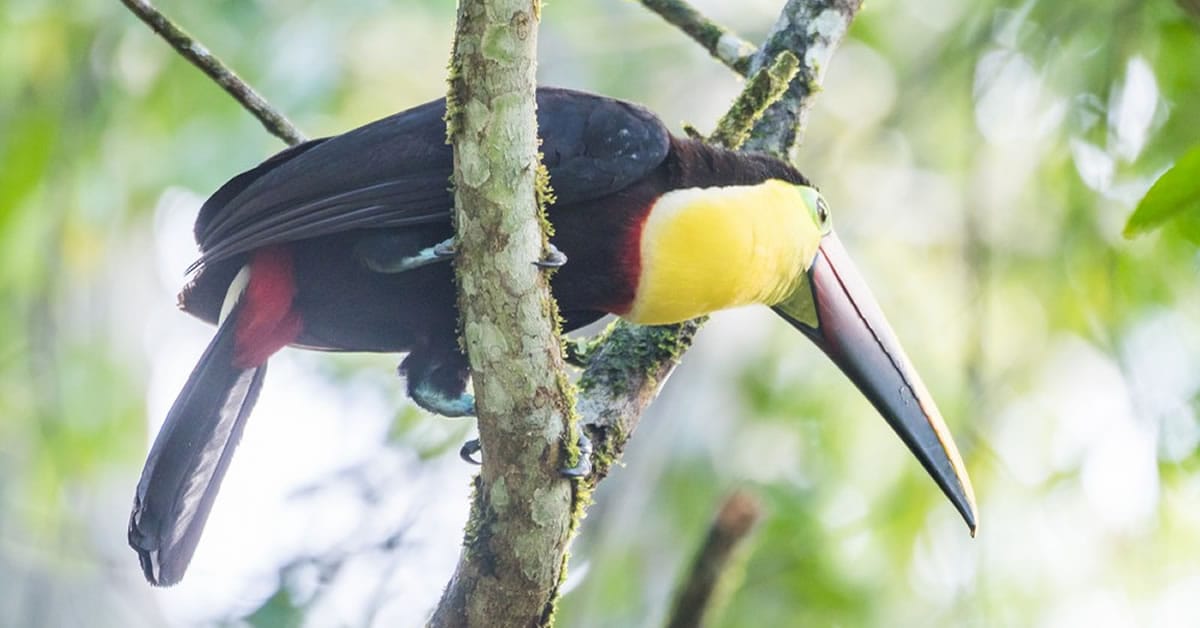
In the evening, heavy rain starts to pour down on the tin roof of my rustic cabin which was located next to the appropriately named ‘Toucan-road’, about 15 minutes walk from the main road in Cocles. While I fall asleep easily with the peaceful sounds of the rain, the howler monkeys defend their territory. The sound they produce is impressive and reminded me I was in the middle of the wilderness. Around 6 am, I took my breakfast outside, in front of the cabin, while the rain had given way to the sun. After the first sip of my tea, an agouti passed by roughly two meters in front of me. Behind it, the toucans were hopping on the branches in one of the huge trees . After finishing my breakfast and observing the wildlife for a few hours, I walked down to the beach and enjoyed a dip in the ocean. This was my daily routine in the Puerto Viejo area. Welcome to Costa Rica!

After 10 days of exploring different areas around Puerto Viejo, I made my way to Santa Elena for a visit to its national parks before moving to higher elevations in the Copey district about 70 kilometers South of San José. Finally, I would spent 4 nights in Tortuguero. Because I had to rely on public transportation, I had to spent a night in San José in between moving from one location to the next. Cata Bed and Breakfast would become my home in the capital city. A young couple with five cats and a flawed dog had opened their home to travellers. The cats were shy at first but when I returned for the umpteenth time, they were already meowing for attention at the gate on my arrival.
the Puerto Viejo area, experiencing the wilderness
As mentioned before, I started my trip in the Puerto Viejo area which consists of Cahuita, Puerto Viejo, Cocles, Punta Uva and Manzanillo. It is located 164 kilometers from San José in the Southeast of the country. My first stop was in Cocles where I stayed with Mike, an American surfer. The majority of the tourists were the typical backpackers who all stayed at hostels next to the main road. The beauty of this region however, is that you can find remote cabins just a 15-minute walk from the same road. Mike lived at such a location and had a cabin for rent.

Away from the parties and away from human noise, but with the sound of the jungle, I had three amazing days in Mike’s little paradise. At the nearby Super Negro (local supermarket) I bought my granola, greek yogurt and tea which I enjoyed for breakfast with the wildlife directly in front of me. After breakfast I usually had an interesting chat with Mike while walking around the property looking for toucans. He was an interesting character walking around in his shorts and repairing a surfboard every now and then.
Late morning I left to town to enjoy a casado Caribeño (chicken thighs flavored with coconut milk, lime and cane sugar accompanied with the typical rice and beans) followed by a stroll on the beach and a swim. On the way back to my cabin, I picked up a delicious bread which I enjoyed for dinner while things got dark around the cabin and the jungle came back alive. Most nights, the rain poured down which added to the experience. It was rustic and back to basic which was exactly what I was looking for. One night though, I found a huge toad in my shower at which moment I called Mike for help. Before he was about to use the broom to swipe the animal out of the cabin, it had somehow disappeared. It must have fled through the shower drain which meant it probably could come back the same way at any time. Every visit to the bathroom was a bit of an adventure from that moment onwards…

Evenings were typically basic but magical at the same time. In complete darkness I turned on the light in the outdoor kitchen and enjoyed some bread before going to bed around 8 or 9 pm. I went to bed early because I found the nights the be very enjoyable. I listened to the sound of the animals and the rain, great. Also, I wanted to get up the next morning around 5:30 am to enjoy my breakfast while watching the active animals in front of me. So, I had many reasons to go to bed early. Unfortunately I had only booked three nights at Mike’s place…
The next days I stayed nearby in another cabin before moving to Cahuita. I rented a bike and explored Punta Uva and Manzanillo, two different places but both within easy reach from Cocles. What I enjoyed the most in this part of Costa Rica was the freedom and relaxed atmosphere due to the local people and lack of tourists. You can travel independently here and don’t need tours and guides for everything. I spent a day on the bike and encountered all sorts of animals from different birds to howler monkeys.

Where most village are within easy reach on the bike, in order to visit and explore Cahuita I had to take a bus. I had booked four nights at the Alouatta lodge where I stayed in another great rustic cabin away from the road and tourists. From the cabin I could hike in about 15 minutes to the top of the hill which offered amazing views of the jungle and all the way to the ocean. The first morning I spotted several mealy amazons and a beautiful toucan with monkeys howling in the background. I had found another gem in touristy Costa Rica…

Cahuita has a different feel than Puerto Viejo. It is less developed and definitely has fewer tourists. It does feature a long black beach with several lodges next to the adjacent road. The main attraction of Cahuita is its national park which draws the attention of many tourists. The vast majority however, doesn’t stay in town but visit from Puerto Viejo. The national park is a long path next to the beach where you can encounter a variety of animals ranging from monkeys and sloths to snakes and many more. If you pay attention, you can also see less known animals like Caribbean hermit crabs.

Soon after entry to the park, I spotted the usual suspects. Capuchin and howler monkeys were all around and when I saw people staring straight up, a big flurry ball could be spotted which meant a sloth was taking things slow in the trees. At times I left the main path to have a look from the beach. This meant a nice escape from the touristy highway, a new perspective on the trees and a view at the ocean at the same time. Since there were hardly any people on the beach, it also meant I could spot some animals up close. It was particularly nice to spend some time with a bunch of monkeys without being disturbed by other people.
When I was more or less halfway in the park, some people pointed out a beautiful snake in the trees. It was camouflaged quite well and pretty thin, so not easy to spot. When I finally saw the venomous reptile (venomous to other animals not to humans), I took my camera out of the bag and took a few minutes to get a nice close-up before moving on and explore the remainder of the park.

Since I had several days in Cahuita, I took things easy. I explored the town and discovered some restaurants and a local bakery with homemade bread. The beach had few surprises for me after a few days and I walked up and down the road next to the beach in order to look for animals. In addition to spotting monkeys, lizards and a toucan, I also enjoyed some nice food at the Cabinas Algebra. The friendly owners there also informed me about a night tour at the Wildlife lodge which would allow me to see nocturnal animals in their beautifully designed garden and the adjacent forest.
Ever since my arrival in Costa Rica I had been looking for the red-eyed tree frog. I was hoping to see it during the day and checked out almost every banana leaf I came across. Unfortunately I hadn’t seen one and decided to be shown around by Fernando from the Wildlife lodge. This turned out to be a great decision. First of all, Fernando was quite hilarious with a great sense of humor. In addition to spotting a few of the famous frogs, we also saw a yelash palm pitviper, some crazy looking lizards and plenty of other snakes and frogs. It turned out to be a very nice tour which allowed me to see different animals and have a laugh or two. On the way back to my cabin, the Uber-driver suddenly stopped on the dirt road. A boa-constrictor was crossing the street…

The last day in Cahuita, I had a special adventure in mind. Trying to avoid the main tourist spots, I discussed the option to explore a remote waterfall when I stayed at Mike’s cabin a few days before. In order to visit the Keköldi waterfall, I needed a guide from the Costa Rican indigenous community that lives in the jungle nearby. Mike knew a local named Franklin who could show me the way. I took a local bus to the starting point of the trail where I met my guide. Without the presence of any other tourist, we started the ascent…
We walked through the mud and crossed rivers. After about ten minutes I realized my shoes would not survive the day. Once I had accepted the situation and walked knee deep in the mud and water without even noticing, we started chatting and joking around. It didn’t take too long though before Franklin suddenly stopped and looked very seriously at me. He spotted the most feared snake in the region, the terciopelo. This highly venomous pit viper was only two meters away from us. Franklin asked me to step away and wait for five minutes. When we continued our hike, the snake was gone. Not sure what Franklin had done but his machete still looked clean as a whistle…

With a mix of excitement and anxious moments left behind, we got back in the mud. The final part of the hike was a steep downhill. The slippery trail turned out to be very challenging and after a few minutes I had to accept that not only my shoes but also my pants would not survive the day. When we finally arrived at the objective of the day, the waterfall, everything was forgotten though. A true spectacle in the middle of nature begged to be admired and so we did. It was only Franklin and myself there which was nice. No phones or selfie-madness of a bunch of millenials to be distracted by…

After 1,5 hours of hiking in the heat and given that my clothes were covered in mud and dirt, it was a pleasure to change into my shorts and go for a refreshing swim under the waterfall. Half an hour later, time had come to make our way back to civilisation. I tried to remove the mud from my pants and shoes as much as possible before entering the bus. It was impossible to not leave any traces behind though…
Monteverde, all about cloud forests
After an exciting time in the Puerto Viejo area, I visited Monteverde. Where Puerto Viejo has a rather authentic and traditional feel without the presence of mass tourism (at least this time of year), Santa Elena is the complete opposite. The area is referred to as Monteverde, due to the famous cloud forest, but the main town is Santa Elena, which is nothing more than a tourist hub. It was a bit of shock compared to Puerto Viejo and I found it truly depressing. Luckily I didn’t come here for a city trip but to enjoy nature and spot some animals…

The town of Santa Elena is surrounded by three national parks with Monteverde cloud forest being the most famous. Santa Elena cloud forest provides a supposedly nice alternative and Curi Cancha is known for its birdwatching. Then, if you want to get rid of your well-earned money, you can participate in all sorts of activities. They offer ziplining, bungee jumping and you can conquer a series of suspension bridges. Some of these activities will cost you at least 100 USD, easily…
I focused on wildlife and therefore skipped the activities. I visited Curi Cancha first since I expected it to be quiet and hoped to see some nice birds there. Because Monteverde cloud forest has one suspension bridge, I opted to visit that park over Santa Elena cloud forest on the second day and hoped the crowds wouldn’t be too bad. From my rental apartment I could walk to both parks in under an hour which was an added bonus and gave me flexibility in when to go and when to leave.

I arrived at Curi Cancha at 7 am when the park opened its doors. After registration I noticed a few people outside who were clearly waiting. Apparently their guide was about to show up and it turned out I could still join them for some birdwatching. In the next 2,5 hours the weather wasn’t the best and we had quite a large group, not the best ingredients to see a lot of birds. In addition, our guide was rather loud (rule number one with birdwatching is “be quiet”) so no need to mention that the feathered friends stayed out of sight. I did pay attention where the guide expected to see some birds and since the ticket was valid until 4 pm, I decided to return after lunch for round two…
Where several guided groups walked around the park in the morning, the afternoon was very, very quiet. The weather was still variable but due to the lack of other people, it was a pleasure to explore the different paths with the hope to spot some exotic birds. The resplendent quetzal had been seen the previous day but, unfortunately, didn’t show up this day (or I missed it…). I did see plenty of hummingbirds and some birds I had never seen before. the yellow-faced grassquit and the silver-throated tanager. Spotting these birds on my own without any other people around, felt quite special. I guess I’m slowly becoming more and more of a ‘birder’…

After a full day in Curi Cancha, I returned satisfied to my apartment. Next to my apartment, restaurant Nativo offered delicious food. The waitresses were annoying but visiting Santa Elena was so uninviting that I was willing to ‘pay the price’ to deal with these ladies. The menu contained rice with shrimp as well as burgers with homemade fries, dishes I tried on consecutive evenings. Fortunately, the quality of the food outweighed the waitresses’ service…
The next morning, I left early for a visit to Monteverde cloud forest. On arrival, I noticed quite some cars in the parking which made me a bit anxious of crowds in the forest. To my own surprise, the trails were almost empty. Even at the suspension bridge, the highlight of the park, there were hardly any people. Walking around certainly offered some of the magical moments often mentioned in connection with cloud forests. The suspension bridge, allowing visitors to have a look from a different angle, was a nice addition. Unfortunately there weren’t any birds around in the canopy when I crossed the bridge. I would not recommend the Monteverde cloud forest to spot wildlife in general. However, to wander around and experience a magical forest, this is a great option.

Copey, a refreshing change
After Monteverde, I was looking forward to a place without tourists. In the last few weeks I had awakened the ‘birder’ inside me, so I figured a trip into the mountains in central Costa Rica could be nice. San Gerardo de Dota is the prime spot for birdwatching but is not that easy to reach with public transportation. To keep things simple, I visited Iyok Ami in Copey which offered similar terrain but was next to the road and therefore accessible by bus.
On arrival at the guesthouse at 2800 meters, I was surprised to find a mountain hut typical for the Alps. Bedrich, the owner, was clearly passionate about his lodge and its surroundings. He kept talking about the history, geology and flora and fauna. According to himself, he had to reduce his coffee intake because he suffered from ADHD. It explained a lot…

The cloud forests in Copey and San Gerardo de Dota are known for being home to the replendent quetzal. Breeding season is in March and April but some of them are around all year. I guess they simply can’t resist the wild avocado trees. Like most accommodations in this area, Iyok Ami had its own trails which could be explored independently. I looked for the quetzal and emerald toucanet but found a lot of hummingbirds and some other exotic birds instead. Observing the volcano hummingbird, one of the smallest in the world with its 8 cm, was one of the highlights!
The hut offered a nice shelter during rain storms and had some delicious food as well. The first day, I was the only guest so it was the perfect retreat for me with the quietest night of the entire trip. Since it was located just under three kilometers above sea level, I needed several layers including my down jacket at times, who would have thought that when booking a trip to Costa Rica. Personally I really enjoyed the fresh air, especially after the hot and humid weather I had experienced earlier in the trip.

Copey opened my eyes and got me more interested in birdwatching. San Gerardo de Dota is now on my list for future trips. Without a doubt, I’ll go look for the resplendent quetzal and all varieties of toucans, be it in Costa Rica or in other Central American countries. I’m not sure how enjoyable the trails are in breeding season with people from all over the world looking for the same bird. One positive is that the millenials and gen Z-ers are generally not interested in birds so I’d only have to deal with older generations. I’ll probably have to be a bit creative to find a good balance between the probability to see the birds and still find a pieceful getaway.
A word about hospitality…
Costa Rica is probably the world’s number one destination when it comes to ecotourism. Tourism is its main industry and price levels are the highest of Central America. As a result, I was expecting a certain level of hospitality. Well, I couldn’t be more wrong here…
In January, I already contacted some accommodations in San José about storing some of my luggage so I could travel light. I sent photos and dimensions of the bags to avoid disappointments. Even though Jungla B&B agreed on storing my bags, they decided differently on arrival which was extremely annoting and caused some last-minute stress. Other hotels would reject my reservation if I booked through booking.com even though they advertised on the same platform. Of course, these issues are not true for all hotels. In fact, I stayed at some really nice accommodations with great hospitality during my trip.

Buses run very infrequently, even to the most sought-after destinations and if they run it’s almost impossible to buy tickets in advance. The most frustrating of issues with hospitality in Costa Rica is probably the SINAC-website. In order to visit many national parks of the country, you’ll have to get a ticket in advance. There is no option to buy a ticket at the park’s entrance. You can buy the ticket only on the SINAC-website and guess what… this website is simply inaccessible. I tried to load the website every day in Chrome and Firefox for about a month without success. Well done Costa Rica!
It’s like the owner of one of the accommodations said: “Costa Rica has all the potential to be a first-world country but for some reason we prefer to be a third-world country”.
Tortuguero, mass tourism in Costa Rica
The final stop of my trip was Tortuguero, a village in the Northeast of the country. It translates into ‘turtle village’ because its beaches are key nesting sites for four species of sea turtles. This is also the reason masses of tourists visit this area, something I soon noticed. The journey from San José has transfers in Cariari and la Pavona. In the latter it became clear how touristy Tortuguero actually is. Herds of people had just arrived by shuttle or bus and were waiting to get on a boat to the final destination. It was a bit shocking to be honest…

On arrival in the village, things did not really improve. The town of Tortuguero is as depressing as Santa Elena. It consists of a long street with souvenir shops, unattractive restaurants and a lot of touts. It had absolutely nothing authentic. Once I had finished my 6 USD smoothie, I took a boat to San Francisco. No guys, of course this is not the famous city on the U.S. West coast but a tiny settlement near Tortuguero where my accommodation was located. Unlike Tortuguero, this village doesn’t feel touristy with locals living their daily life and kids playing on the street. The downside is that you can only leave the village by boat which runs only a couple of times a day…
My accommodation had already informed me about all the tours they offered before arrival. At check-in, they repeated their offer, even before I had seen my room. A few minutes later, when I had just put my bags in the room, the tour guide had arrived to make sure I would sign up for several tours. At this point in time, I wanted to leave Tortuguero as soon as possible. My little piece of paradise in Cocles where I could explore freely and undisturbed, suddenly felt very far away…

Given that I had already paid for four nights, I decided to make the most of it. I visited Cerro Tortuguero which is easily accessible from San Francisco. It’s only a short hike to the platform at the top where a beautiful view on the jungle and waterways awaits. I told a French family, who were also enjoying the views, that I hoped to see a toucan up close. To everyone’s surprise, not much later, a big-beaked bird appeared shortly after, just a few meters away. To make things even better, four other chestnut-mandibles toucans arrived in the trees in front of the platform and entertained us for at least 20 minutes, what a treat!
In the evening I joined a turtle-tour, something which cannot be done independently. Guides are mandatory from a conservation perspective. Together with a Dutch family and guide Owen, I arrived at the beach and was assigned a specific location and time slot. We were surrounded by many other groups and had to wait to witness one part of the ‘process’ as Owen called it. To avoid tourists going all over the beach and disturb the turtles, people can only see one turtle arriving on the beach, laying or covering the eggs or leaving the beach and go back into the ocean. We were allowed to see one green turtle covering her eggs. As a bonus, I don’t know why, we also got to see her going back into the water.

It was amazing to witness such an intimate moment of such a large animal. At the same time it felt absolutely wrong to follow her with so many people. When she made her way back to the ocean, there were at least 50 people behind her. And this turtle was not the only one to be followed this evening. In complete darkness (we were not allowed to use any lights), we tried to find the boat without losing each other. We got back at the hotel after midnight with mixed feelings…
The last days in Costa Rica were spent as independently as possible. I explored every part of the so-called jaguar trail in the national park, adjacent to the town of Tortuguero. It’s basically one long path alongside the beach for the most part. One might encounter the elusive cat, hence the name, but the likelihood is extremely low during the day. I was lucky to observe a few spider monkeys up close and spent the majority of the time looking for the great green macaw and blue jeans dart frogs.

The great green macaws can easily be heard thanks to their very clear, loud call. This also makes spotting them relatively easy, despite the fact that they blend remarkably well into the leaves. Finding the frog turned out to be a more challenging task. Quite some people I met on the trail had seen several of these tiny animals but I struggled to spot the 2 cm bright red animal. I visited the park both in the morning and afternoon on two consecutive days and on my last visit I finally saw a few of these toxic creatures at the start of the trail. My mission was completed…
Even though I had seen some animals I had never seen before, including the green turtle, and the beautiful and overwhelming nature of the region, I was looking forward to leave Tortuguero. It might be the perfect destination for many but mass tourism has ruined Tortuguero for me. On the way back to San José I planned my final lunch of the trip. A fancy meal at Naans and Curries turned out to be a nice way to finish the trip.
Conclusion
Costa Rica is rated the number one country in terms of ecotourism and I can see why. Wildlife and nature in general are simply overwhelming. This attracts crowds from all over the world which creates a challenge for me since I like quiet places and I prefer to figure things out on my own instead of joining tour after tour. I therefore chose to visit the country outside high season for the majority.
I probably had the best time overall in the Puerto Viejo area. Late June it was pretty quiet and I could really experience the wilderness. Sometimes it’s not only about spotting as many animals as possible but the excitement (and slight fear…) of a potential encounter with whatever animal anytime and anywhere, tickles the senses. This area is less developed and animals roam around freely where I found other areas in Costa Rica to be much more organized with wildlife being restricted to parks located around a very touristy town. Also, the combination of wildlife and deserted beaches nearby wasn’t too bad…

Monteverde and Tortuguero are two examples of touristy areas. Monteverde was manageable for me because it wasn’t too busy outside Santa Elena, most likely because it wasn’t peak season. I was actually surprised to find a lot of empty paths in the famous cloud forest. Tortuguero on the other hand, was way too touristy for my liking. If I had known in advance, I would not have visited this relatively expensive area.
My visit to Curi Cancha already awakened the birder in me but Copey and the stories about San Gerardo de Dota really opened my eyes. This area was a pleasant surprise with its beauty and different feel than the other places I visited during my trip. The lack of tourists, or people in general, was also great but this might be different in other times of the year, for example when people come looking for the replendent quetzal in the breeding season.
Overall, my trip to Costa Rica had been amazing and different than any other trip I have done so far. There are still plenty of national parks I haven’t visited and it won’t hurt to go back to certain places. It’s probably not the last time for me in this part of the world…
Click here to see more pictures of my trip to Costa Rica!
Be First to Comment