Initially Cambodia was just a transit country on the agenda. I had to travel from Ho Chi Minh in Vietnam to Bangkok in Thailand and there is a country in between but it turned out to be quite interesting. From tough history to impressive culture and from disgusting sex-tourists to an unexpected paradise…
I traveled from Chau Doc, which is the last town in Vietnam before you cross the border, by boat to Phnom Penh which is the capital of Cambodia. After some formalities at the border, one needs a visa to enter Cambodia, a nice boatride takes you to the riverside where a dozen tuktuk-drivers are waiting… The first thing I noticed was that the people were more open compared to Vietnamese. Their level of English is much higher and the drivers were joking all the time, a nice welcome. The city is quite big with around a million inhabitants but it feels like a town, it’s pleasant. The biggest site of Phnom Penh is the Royal Palace. The king recently died so the palace was closed, too bad both for the king and for me!
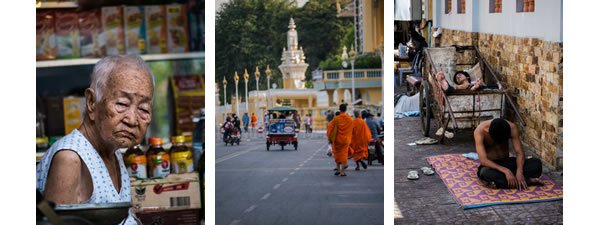
The other sites were not that interesting but there was still enough to see. Markets are abundant in Asia and in Phnom Penh I stayed right in the middle of some. Some of the salesmen offer a typical Kodak-moment! Another thing I noticed is that Cambodians can sleep in any position or situation. They sleep on their motorbike, on the floor, between the meat in their foodstall, just anywhere. They simply install a hammock and they’re good to go!
When you’re in Cambodia you will be confronted with some really tough history. Phnom Penh is associated with some of the worst atrocities of the Khmer Rouge regime. The Khmer Rouge was the name given to the followers of the Communist Party of Kampuchea. The party was formed in 1968 and ruled between 1975 and 1979, led by Pol Pot. In April 1975, the Communist Khmer Rouge defeated the unpopular US-backed regime of Lon Nol. As troops for the Khmer Rouge marched into the city, the streets were filled with residents celebrating their arrival and Nol’s defeat. But jubilation quickly turned to terror as within hours the troops had given orders for the entire city of 2 million to evacuate to the countryside. The evacuation was total and included the old and the infirm. Many thousands died leaving the city. They used the threat of US bombings as the reasoning for the evacuation, but the real motivation was their desire to turn Cambodia into a purely agrarian-based communist society. Pol Pot wanted to remove social institutions and cities had to be evacuated which affected the Chinese and Vietnamese, who were unused to agricultural work. In order to maintain this society enemies had to be killed. Among these enemies were professionals, intellectuals, Vietnamese, Chinese, economical saboteurs and anyone with connections to former of foreign governments. Estimations of the death toll during the Khmer Rouge era differ between 1.4 and 2.2 million people, making them the most lethal regime in the twentieth-century in terms of people killed as a proportion of the population…
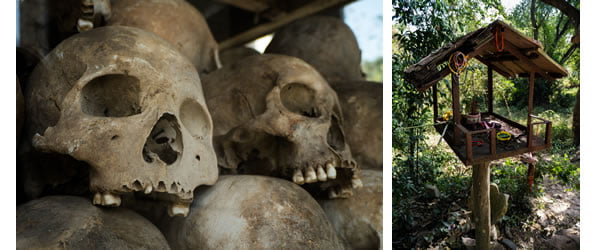
Around 20.000 mass graves have been located all over Cambodia, also known as The Killing Fields. Just 17 kilometer outside Phnom Penh I visited Choeung Ek, which is one of these mass graves. Around 9000 bodies have been found here. Many of the dead were former political prisoners who were kept by the Khmer Rouge in the Tuol Sleng prison or S-21, a former high school. In order to save ammunition, the executions were often carried out using poison, spades or sharpened bamboo sticks. In some cases the children and infants of adult victims were killed by having their heads bashed against the trunks of trees. The rationale was “to stop them growing up and taking revenge for their parents’ deaths.” Next to one of the trees there is a typical Cambodian spirit house…
When you enter the ‘site’ you get an audio guide and you start the tour. All the visitors wonder around the place listening to their headphones trying to capture the horrible history. In around two hours you walk all across the fields and history has been told including audio segments of survivors.
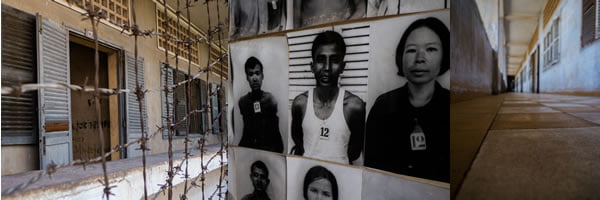
Tuol Sleng prison
Pol Pot died in 1998. Since his death, rumours that he was poisoned have persisted. On September 19, 2007 Nuon Chea, second in command of the Khmer Rouge and its most senior surviving member, was charged with war crimes and crimes against humanity. On July 26, 2010 Kang Kek Iew, director of S-21, was convicted of crimes against humanity and sentenced to 35 years’ imprisonment. On February 2, 2012, his sentence was extended to life imprisonment by the Extraordinary Chambers in the Courts of Cambodia. Enough history lessons…
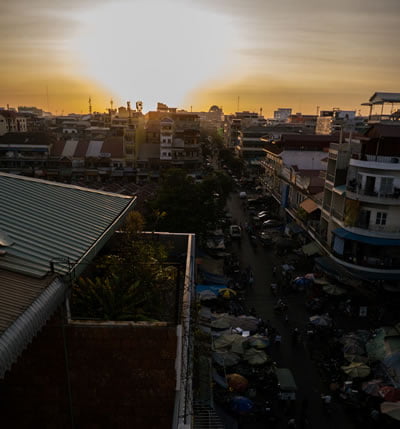
After a rather heavy morning, time had come to go back to the city center to relax a little bit trying to leave the sad history behind. Unfortunately there is more sad news to tell regarding Phnom Penh. Before going to Cambodia I was aware of the country being a popular spot for sex-tourists. Walking around town one will see a huge number of old Western single men drinking a beer in the middle of the day surrounded by Cambodian girls. Some of the girls seem to be adult, others look a tiny bit too young. Then there are the bars with surprising names as “The horny bar”, no explanation required I’d say so… And to top it all off, in the room of my guesthouse it was mentioned it is prohibited to take children into my room. Some things should be obvious I’d think but apparently it has to be mentioned in Cambodia. After a sad afternoon I went for a so-called sundowner at a panorama-room in one of the guesthouses. At least, the day ended well…
After applying for my Indian Visa, I took the bus to Siem Reap. Both Phnom Penh and Siem Reap are on the tourist highway, Siem Reap being the worst. The town is nothing more than a tourist shithole. Don’t expect any Cambodian culture in the town, it consists of pubs, restaurants and travel agencies. The beauty of Siem Reap lies definitely outside the town itself.
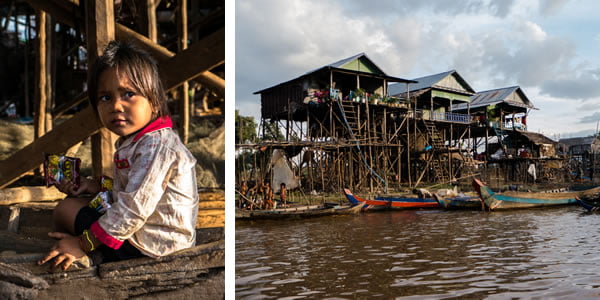
Together with two German ladies, Jutta and Maria, I explored Kampung Phluk which is a so-called floating village. Jutta and Maria are two cousins enjoying their freedom in the later stages of life by exploring Asia. They seemed to have a great time and were enjoying every bit and they were great company too. A one hour tuktuk-ride took us to the starting point of the boat trip that took us through the village with the stilted houses and to a floating mangrove forest. On the way back we were dropped off at a colourful temple and we walked around a small town. People were used to some tourists but the kids were still excited to see us!
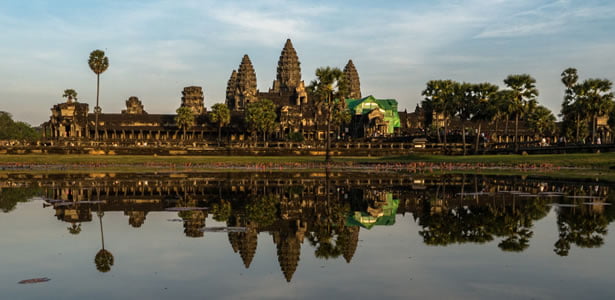
Siem Reap is best known for the temples of Angkor Wat of course. Being there in the absolute high season I tried to figure out the best way to visit while avoiding the crowds. Early morning on new year’s day seemed ideal. Starting at 5 am would hopefully mean most people were either still partying or asleep. I went to bed at 10:30 pm, missed the actual celebration of new year, and woke up again at 4:30 am. I took my bike and cycled for around 30 minutes in silence to arrive at Angkor Wat only to notice my plan did not work out! Around 1000 people were at the site to watch the sunrise, what a disappointment. Luckily everyone left when the actual sun could be seen (why?!?!?), so I still had a good spot…
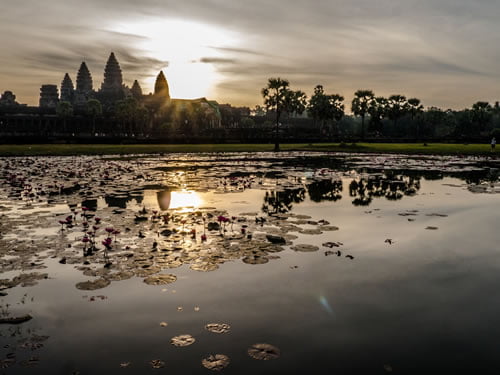
I found the temple to be really impressive. It is the largest Hindu temple complex and the largest religious monument in the world. The temple was built by King Suryavarman II in the early 12th century. It is designed to represent Mount Meru, home of the devas in Hindu mythology. the central quincunx of towers symbolises the five peaks of the mountain, and the walls and moat the surrounding mountain ranges and ocean. Unlike most Khmer temples, Angkor Wat is oriented to the West rather than the East. This indicates that Suryavarman intended it to serve as his funerary temple. Unlike other temples, Angkor Wat is still intact, probably due to the many restoration works supported by UNESCO. I really enjoyed walking around the site. It was very peaceful and the fact you could easily understand the design without too much imagination was nice. The temple is surrounded by galleries showing different ancient stories. The fact it is built in the early 12th century makes that even more impressive. The labour force must have run into the thousands including many highly skilled artisans…
After checking out some other temples around the area including the famous Bayon temple, known for ‘the faces’ (Jasper, after which one is Thom named?), and Ta Prohm, known for trees growing out of the ruins, I made my way back to Phnom Penh. I had to pick up my Indian visa before continuing my journey. When I handed my documents to the officer at the Embassy, he was arrogant and rude so I was not confident the visa would be in my passport. In case my application would have been declined, I had a serious problem as I had already booked flights to and in India for example… After waiting a bit and trying to control my nerves, it turned out to be just fine!
I continued my journey to Sihanoukville, the starting point if one wants to visit Koh Rong. Koh Rong is said to be one of the last remaining paradise islands as they used to be in Thailand some 20 or 30 years ago. I was told the only boat to the island departs at 2 pm and I arrived in town at 1 pm. A motorbike took me to a ticket counter, I bought the ticket and went straight to the pier. At 5 pm I arrived at the island only to notice I was at the wrong side. The front side contained already a small touristy village and I was looking for paradise, not for other tourists. I had to go to Lonely Beach which is located on the other side, another 3 hour boatride… When I arrived the owner told me I was lucky because normally you can only get to Lonely Beach with their own ferry. Well, at least I had made it to paradise!

Lonely Beach is an appropriate name. There is a beautiful white sandy beach which has to be shared with the guests of Lonely Beach guesthouse. There were a shocking 8 guests including myself. The water was turqoise, palm trees and coconuts were abundant and the weather was hot but with a sometimes refreshing breeze. Activities on the island consist of swimming, being lazy in the hammock, sunbathing and observing the many small animals on the island. Hundreds of little crabs popped out of their holes and dragonflies were everywhere. At one point we almost walked into a huge spider (check out the picture in the gallery). I told Warren and Gary, two Ozzies I went for a walk with, we had to look out for spiders and snakes just before Warren had a huge cobweb in front of his face. Luckily I was walking behind the Ozzies…

The guesthouse was owned by Yugi, a German who lived on the island during European winters. He was not a professional hotelmanager at all but he was friendly and he tried. For me that was exactly what this place needed, a laid-back friendly and basic approach… As someone who’s known for not being a true fan of hot weather and beaches, I have to admit I enjoyed every single minute on the island. Lonely Beach is simply to good to dislike!
The last days in Cambodia were spent in Koh Kong, a town just before the border with Thailand and therefore an efficient stopover on my way to Bangkok. Together with Eva, Nathalie and David, three people I had met on the island before, we arrived in this quiet town. After doing not that much the first day besides eating crab, we went for a two-day jungle trekking the next day. A three hour walk through the forest took us to a nice waterfall. Once we jumped into the water, it started to rain and it didn’t stop until the evening. It was rather disappointing because there was not much to do in the rain. We spent most of the time in our hammocks which were also our beds for the night! After a decent barbecue we went to ‘bed’. The next morning most of us were still tired. The hammocks turned out to be quite challenging beds. David got sick, so we were up for an interesting walk back out of the forest. After a substantial number of stops along the way, either for David to empty his stomach or for others to remove another couple of leeches (I had to remove about 20 of them…), we made it back to the road. We were pickup up and took a boatride to another waterfall. The Ta Tai waterfall as this one was called, was more impressive than the first one and we went for another swim to end the day. The next day I left Cambodia by tuktuk to the border…
As I’m writing this post I’m in Bangkok where I had my laptop fixed after several visits to the Pantip Plaza (The IT shopping mall of Thailand) and where I witnessed some Muay Thai Boxing in Lumpinee Stadium. Tonight I will fly to the incredible country of India, to Chennai to be more precise!
Click here if you want to see more pictures of my trip to Cambodia!
Be First to Comment